Two years ago, I completed my first triathlon, the sprint course in Welland, Ontario. Like all firsts, Welland has a special place in my heart so when Dave suggested that I do the long course (2000m swim, 55 km bike, 15 km run), it was hard to say no. I also saw racing in Welland as a good tune-up for other distance racing this summer, especially with the long swim. Being newer and slower in the water, I know that I need as much exposure to different pools and open water as possible, physically and mentally. I also wanted to practise transitions in a race situation, especially getting out of my wetsuit and onto the bike, to see how those splits compared to last year’s and to figure out how I can improve on those times.

When Dave and I got to the race start in the morning, the air was so thick that you could hardly see the canal. There was talk about delaying the race for safety reasons but, by 7:30, the sun had burned through the clouds and we were going to start at 8:00 as originally planned; my wave was at 8:12, which gave me time to do a short warm-up in the water.
Of the three sports – swimming, cycling and running – swimming is the most difficult with asthma. Since I can’t carry my puffer like I can when I ride or run, I have to make sure that I am warmed up (and my lungs are open) before I start. The Welland Canal was a perfect venue for me as I was able to swim 50 strokes, tread water, swim 50, tread, and so on while the first waves were starting. By the time my wave was called, I was ready and calm; I knew that I had my breathing under control. I felt comfortable throughout the entire 2000m; I never felt the panic that I often do and finished faster than I expected. I felt great getting out of the water and had an easy transition to the bike.
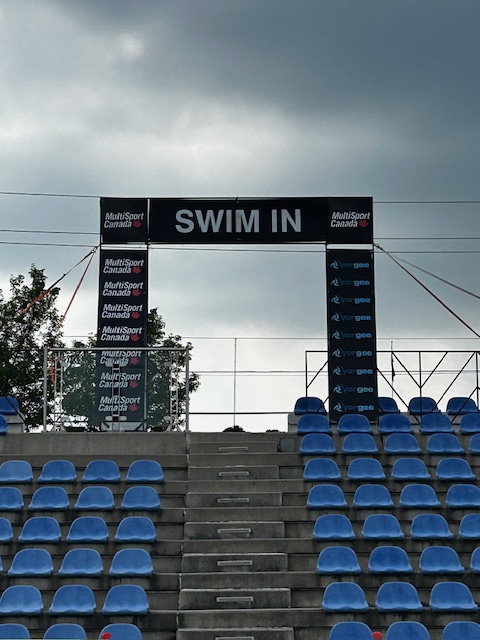
Although I have been working hard at improving endurance and speed on my bike all winter and spring, things feel apart in Welland. The course was flat and it was slightly windy. For whatever reason, I had trouble deciding on what gears to use and eventually decided to stick with the big chain ring, a place where I am quite comfortable. By 20K, though, my right adductor started to tighten. I didn’t think too much about it as it sometimes does this and works itself out. But if that wasn’t bad enough, my stomach was cramping too. By 25k, nothing had improved and all I could think about was getting through the last 30 kilometres of the ride without my stomach exploding. That and my tight leg meant that my pace was slower than I wanted, but I honestly didn’t care. My swim was done and I was happy with it; that was what really mattered in the end.
By the time I got back to transition, I had already decided to run the first 5 kilometres and see how I felt. I had a quick visit to the hot box (a.k.a. porta-potty), relieved the stomach cramping and started my run. I knew it was getting hot (it can often be hard to tell how hot it really is while riding) and I was later told that the humidex was in the high 30’s. My adductor was still tight and I was sensitive to that, but a new problem surfaced; my chest was tight. I had my puffer with me and used it in the first ten minutes, but it had no effect at all. It wasn’t long before I was alternating between walking and running, and my walking segments were gradually taking more time than the run sections. I didn’t want to stop but I was concerned about where this was heading; I was already sick to my stomach, I had a tight muscle and now I was having trouble breathing. I still wanted to get to the 5 kilometre mark, hoping that things would change. After walking with one lady for a kilometre (at that point, there were a lot of people walking or run/walking) and listening to her comments about the air being thick (“I can’t imagine how hard this would be to run in if I had asthma.”) I decided to pull myself off the course at the 4K mark. Things had not improved at all since I started – in fact, they got worse – and I couldn’t foresee any sudden improvement.
That hurt. Running is my favorite part of the triathlon. It is what I really look forward to. But that day, it just wasn’t in the cards. I accepted my decision – no tears and no regret – but I didn’t like it.
But I got what I wanted out of the race – a long morning swim that I am proud of, good transitions and I did finish the swim and bike. Never, ever, did I ever think I would see the day when I only swam and rode. However, I have also had many moments when I wish I had just walked the last 15km of the course so that I did “finish” even though that would have been emotionally harder.
By Tuesday, as I still wasn’t feeling better, I started to worry that I had picked up strep. A quick visit to the doctor confirmed that my throat was “really inflammed” and my chest was “quite tight”, but the rapid strep test was negative. “Being asthmatic does put you at risk when temperatures are extremely high.” (I may have neglected to tell her that I was in a long course triathlon a few days before.) The doctor’s comments reminded me that I did make the right decision at the time. I just can’t mess with asthma.
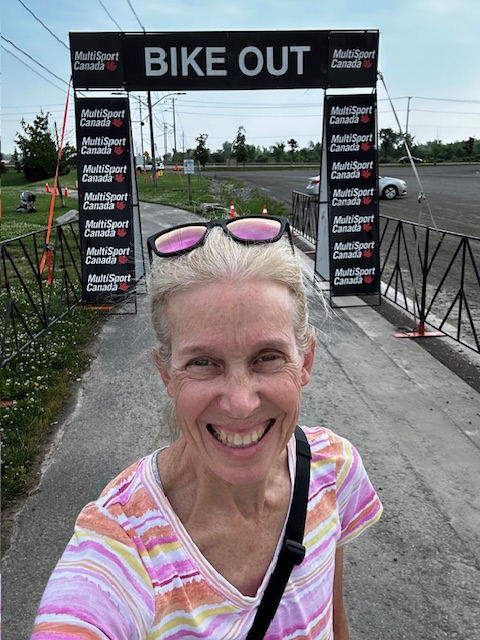
Looking back, I ask myself if I could have done anything different. Riding in a higher gear might have made a difference with my adductor; there is nothing I could have done about my breathing. Moving forward, I question what I should do next time. Obviously, carrying my puffer is not a solution. Slowing down my pace, though, might be as a more conservative effort uses less oxygen; I have been working on that this past week and trying to “retrain my brain.”
One of the things that I love about the sport of triathlon is there is always something to work on and always something to learn. Jumping into triathlon as an asthmatic, practically non-swimming “silver master” is one of the gutsiest things that I have ever done, but it has also been one of the best.
I will keep moving forward. I will keep challenging myself. I will keep chasing my dreams.
 Cynsspace