Two winters ago, images of weather blankets popped up in one of my social feeds. I didn’t even know what a weather blanket was but, intrigued, I started my search and learned that each row represents the highest temperature of that day of the week. It seemed simple and completely doable, so I parked the idea for a few months.
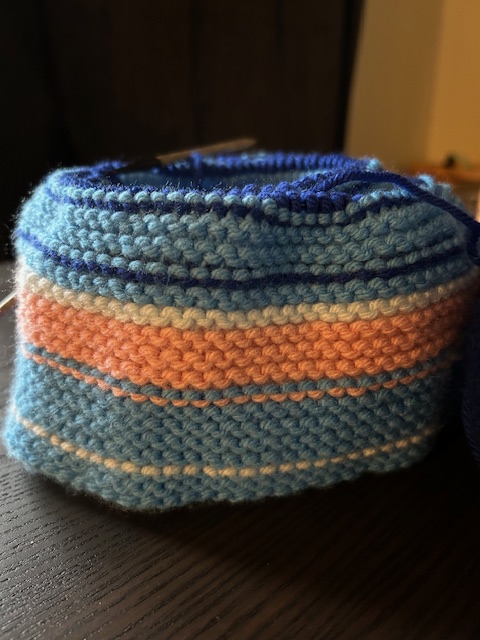
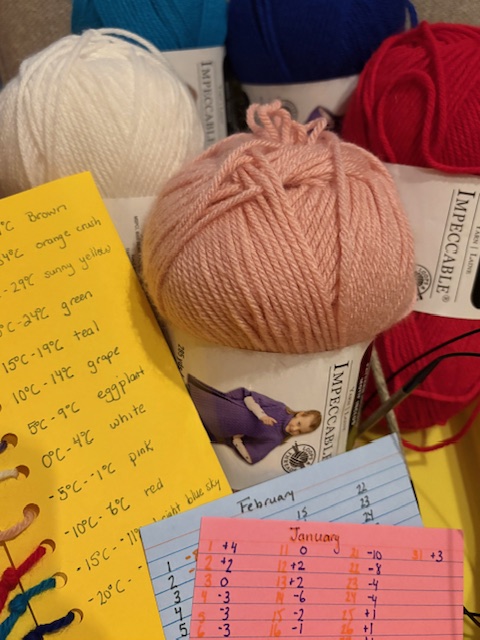
Last December, I decided to plan my own weather blanket project. I set up the temperature scale in 5 degree intervals from +40C to -30C, hoping that I would never have to use the colours for the coldest days. This sums up life in Canada, where you need to be prepared for all kinds of weather. I bought one ball of yarn for each interval and, as it turned out, I hardly used some of them but I also needed to buy a second ball for some of the colours. I decided on purples and blues for the colder temperatures, blues and greens for the spring and fall, and the fire colours (yellow, orange and red) for summer, giving me a total of 14 different colours. Creating a yarn legend (see last picture in this post) helped me to stay organized.
My math brain decided to keep a running record to track my local daily high temperature on a new index card for each month. This seemed a bit unnecessary at first but I appreciated the foresight to do this when I fell behind in tracking or knitting; I could list many temperatures at once and know exactly where I was when I needed to catch up. I think “seeing the end” of catch-up periods gave me a bit more of a focus, or a drive, to keep knitting. Also, changing cards for each month gave me the sense of a new beginning; I was always as excited about getting to the end of one month as I was about starting a new one.
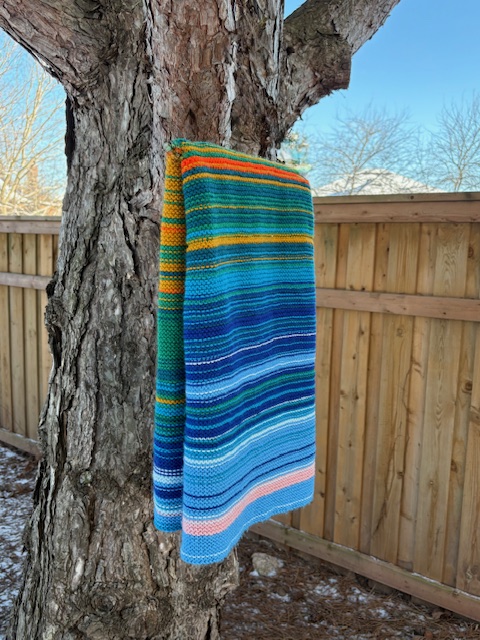
I chose Impeccable Yarn by Loops and Threads because it is warm and a bit lighter (yarn weight 4), which also meant the blanket wouldn’t weigh a lot by the end of the year. I used a 5mm (US 8) 100cm round needle with 160 stitches per row. The rest was easy; I just knit a simple garter stitch from row to row. Every few yarn changes (and there are a lot of them), I weaved and knotted the loose strands between the stitches so that my “workspace” was neat – and I wouldn’t have hundreds of end pieces to worry about when I finished knitting 365 rows. Some people add a border to their weather blanket but I didn’t. Maybe next year.
I didn’t expect this blanket to turn out as well as it did. I am so happy with it that I recently decided to knit another for 2025, using a different set of colours. This means that I have some catching up to do but there is an index card for that.
Happy Knitting.
 Cynsspace