Mont Tremblant is one of my favorite places to visit. Our family has been there twice – once to ski/snowboard and, again, in June 2023 when the Ironman 70.3 ended up being cancelled less than an hour before the start of the race, a result of the wildfires north of Tremblant. Dave and I returned that August for the rescheduled race and, for me, it was the experience of a lifetime – my first half-Ironman and a podium finish with a third place age group award. I was thrilled. Dave and I headed back to Tremblant this June so that I could race the half-Ironman again but it was not the race that I wanted.
I don’t think many athletes knew what the water temperature was that morning. I heard a lot of comments like “I hope it’s not that cold” or “People are taking their time getting started. It might be cold.” We knew that wetsuits were optional but, of the people I spoke with, nobody had any idea what the actual water temperature was. By the time I started my race, I had been standing in my wetsuit on the shore for over an hour so I was likely a bit over-heated. When my feet first touched the water, I said “Oh, wow! That’s cold!” I may have added some colourful language.
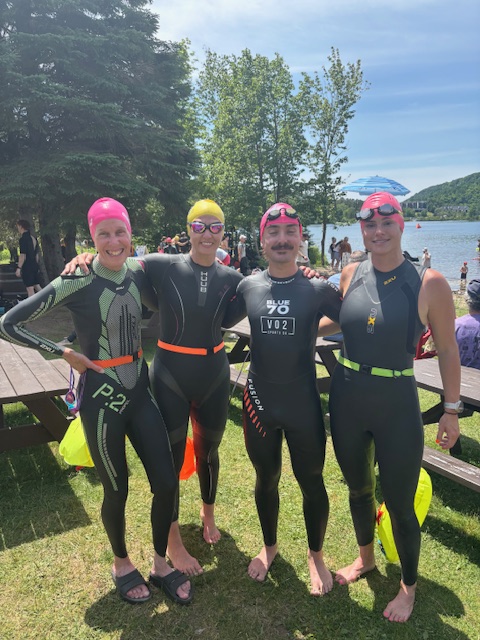
The weather leading up to the race was ideal. When friends and I swam in Lac Tremblant in the afternoon before the event, the water was warm, the sun was high and winds were calm – a perfect set-up for a good swim. Overnight, though, the rain stirred the water and the lake flipped; the cold water moved to the surface and it was a brisk 62F on the morning of the race.
The distance of a half-Ironman swim is 1900 metres. I am comfortable with that distance, slow but comfortable. During the first 500m, I was swimming at my usual pace but my breathing felt “off.” I knew it wasn’t asthma as I wasn’t experiencing the same kind of tightness. I remember asking myself “Am I even inhaling?” as I swam. I focused on breathing in and blowing out, but I couldn’t feel air moving into my chest the way it normally does. I learned later that this was a result of the cold water.
In the next 500 metres, I slowed down quite a bit. There was a lot of stop and go as I kept trying to relax. But I as swam into deeper water, I was getting colder. My hands were starting to numb and I didn’t feel like I was pulling water anymore. By 1300m., I grabbed hold of a kayak.
“How cold is it?” I asked.
“It’s cold!” the kayaker answered with even more colourful language that my own.
“That’s not helping,” I laughed.
“I’m sorry. But it’s cold. And we’re all soaked.”
I stayed with her while I tried to decide what to do. I didn’t know if I had the mental or physical strength to keep swimming in that water. When I looked at my watch, I realized that I might not be able to even meet the time cut-off.
“If you want to keep going,” she said, “I’ll stay with you.”
“You’ll stay with me?”
“Yup. I have your back.”
“Okay. Let’s do it!”
I swam about 25 more metres and stopped. “I’m done.” I stopped my watch and took off my cap.
After that, things are a bit of a blur. I was told to hang onto the kayak while she radioed for a boat and that is the last thing that I clearly remember. I heard “First Aid,” “hypothermic,” “lips are blue,” and the next thing I remember hearing was the sound of a motorboat coming up. Arms over my head, turned around, I was lifted out of the water, pulled onto the boat and bundled in towels. I was scared and wanted to cry. I had no idea what was going on around me.
Another lady was also pulled out of the water after I was; her skin was yellowish-grey and her eyes were bulging. I thought “If I look like that, I am in real trouble.” When we were back on shore and the wet towels were replaced with warm dry towels and blankets, I looked at my feet and realized what kind of shape I was in. I could feel my eyes start to feel with tears again.
The First Aid Rescuers were fantastic. I was glad that I could understand French and hold a conversation as only a few of them spoke English. My body temperature was 32.3C (or was it 33.2C; I was still feeling confused at the time), which explained the uncontrollable shaking. Fortunately, without realizing it at the time, I must have sensed that I was in physical distress during the swim and had the clarity to stop for help. In retrospect, I didn’t recognize that the confusion or sense of “fogginess” during the swim (such as trying to figure out where I was suppose to go – when there were giany buoys in the water to guide me) was also a part of being hypothermic.
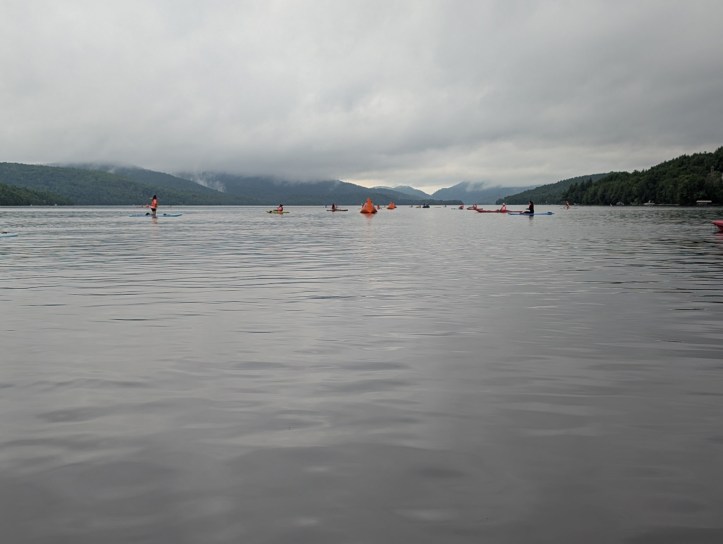
Dave was one of the volunteer kayakers who was helping on the swim portion of the race. I asked the lady who helped me if she could try to find him when they were done and tell him where I was, and she did. Both arrived at First Aid together and, when I saw her, I started to cry. If you know me, you know that I am not an emotional person but the sense of relief and gratitude when I saw Dave and this stranger was overwhelming. Dave “qui porte un chapeau Tilley” was my rock; he is always there for me.
My race was over. I wasn’t upset. I simply accepted the reality of the situation. Even though I had the “all this way” and “all that money” thoughts swirling in my head, I knew that not completing the swim was not because I wasn’t prepared or couldn’t handle the distances. Stopping was an unfortunate result of bad weather.
I am still here. There is always another race.
 Cynsspace