The Ironman swim took place in the Ottawa River, starting and ending at Britannia Beach. The river has a reputation of being a high flow river that has a strong current. Historically, the water temperatures in August are warm. Almost everyone who trained in the Ottawa River durng the spring and early summer posted that the swim goes into the current for the first part, slowing them down significantly going out but giving them a fast return to the beach.
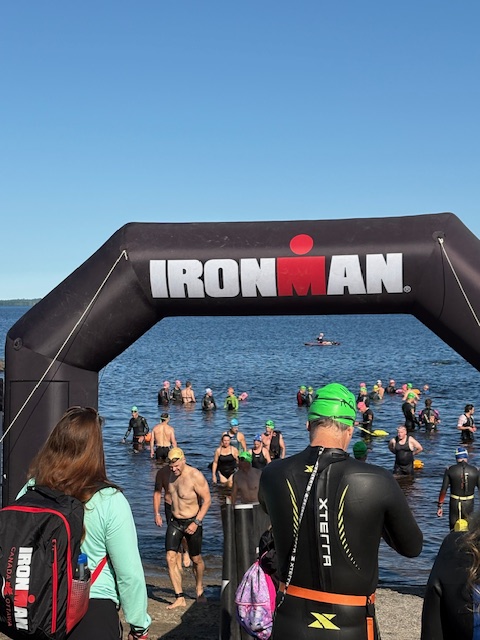
Triathlon is an outdoor sport so there are always a lot of unknown factors until race morning. For me, the best way to handle the unknowns – water temperature, air temperature, direction of current, wave height – is to get as much practice in open water as possible and swim at the race location ahead of time. When my friend, Lara, invited me to swim with her and her friend, Rob, on the Friday before the Ironman, I jumped on board. Lara is an Ironman herself and knows the river well, so I was in expert hands that morning.
The water was almost everything that I hoped it would be: warm with a side of chop, but not overwhelmingly so. Temperature is a real concern on race day as wetsuits are “not legal” if the water temperature is over 24.5C. This means that anyone who wears a wetsuit is not eligible for awards. It also means that everyone who chooses to wear a wetsuit needs to wait for the non-wetsuit swimmers to go first, which increases the numbers at the back. At the practice swim, the temperature was below the 24.5C limit, which gave me a realistic hope that wetsuits would be optional on Sunday morning. This was the first step to calming my swim nerves.
The river current was good. I definitely noticed it but it was similar to many of the swims that I have done in Lake Ontario. However, as the current and amount of chop can change from one day to the next, I had to firmly plant the idea in my brain that I had experience in rougher water and I would be able to handle whatever the river would give us on the Sunday.
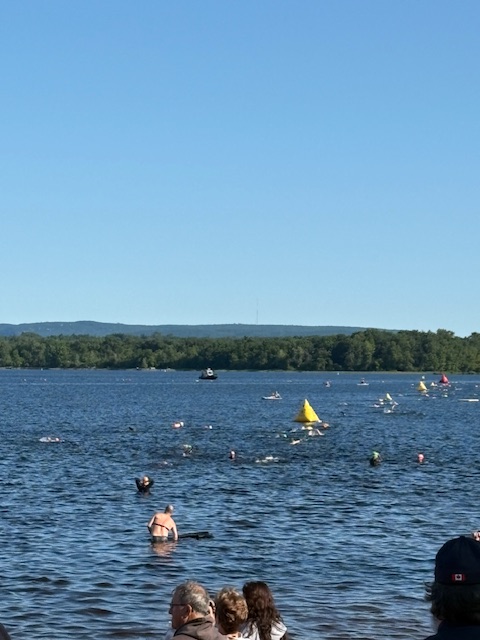
The practice area was a marked 1000 metre loop, exactly the distance that I wanted to swim. While I was primarily there to feel comfortable in the water, I used it as an opportunity to practise my sighting (seeing the buoys ahead and swimming towards them, and trying not to swim off course). As expected, we swam perpendicular to the current and, then, into it at the start and that made it easy for the chop to push me off course. I am typically a bilateral breather, which means I breathe once every 3 strokes (sometimes, I will go 4 or 5) and my sighting is fairly good but I couldn’t swim a straight line from point to point. Somehow, I got the idea to change the direction of my breathing so that I would breathe to the right, then to the left, then look forward to the buoy and breathe, then resume the pattern starting on the left side. My arms were constantly moving but my breathing alternated from right to left to centre to left to right to centre to right to left to centre and so on. I have never read this or seen this technique before but, for me, it worked; my sighting improved significantly and I was swimming straighter. When I turned around to head back to the beach, I noticed the push of the current more. I felt myself on the river’s surface and being carried back to shore; it was much easier than the first part.
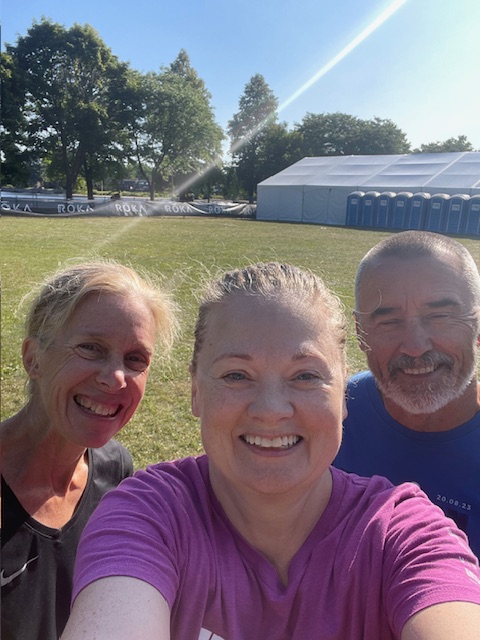
When I finished the practice swim, I was feeling great: comfortable in the river, strong, on pace for what I hoped to swim on the Sunday and confident with my sighting. I am grateful to Lara and Rob for inviting me to join them. For the first time all summer, I felt ready to take on the 3 800 metre swim.
 Cynsspace